Search This Blog

Showing posts with label auto accident. Show all posts

Monday, March 25, 2013

What Exactly Is Whiplash?

When you think of whiplash, most people immediately think “car accident.” But a fall or many types of repetitive movement may also cause whiplash. Sometimes the symptoms from whiplash take days or even weeks to manifest themselves, but the damage it causes can last for years.

What exactly is whiplash? It’s a condition in which the joints in the back of the neck, joints that usually slide easily over one another, are forced together, causing damage to the nerves, discs, ligaments and muscles all around them.

The symptoms? Generally, these include headaches, dizziness, neck and arm pain, decreased attention span, an inability to focus and fatigue. These symptoms can be both very painful and downright debilitating to the whiplash sufferer.

It helps to come into our practice immediately for a thorough examination if you have been involved in an accident and suspect that you might be the victim of a whiplash injury. The earlier you establish the proper intervention, via chiropractic adjustments, the better your chances for a full recovery.

Of course, chiropractic adjustments also help older whiplash injuries, but recovery is usually slower and care during the acute phase generally takes longer.

We manage whiplash injuries with careful and precise neck adjustments, sometimes ice and rehabilitative exercises that are designed to address the injured neck and shoulder muscles and joints. This has been shown to be very effective in managing the symptoms of whiplash, particularly the headaches that often accompany this type of injury.

Visit www.atlanticchirofl.com for more info!

Friday, January 18, 2013

Get in the Car... Right!

Sciatica and back painDid you know that there is a proper way to get in and out of your car? Well, believe it or not, there is, and it is especially important that seniors and those who have arthritis practice these simple maneuvers to enter and exit a car safely.
• Swivel in and out – Enter the car backwards and then swing your legs into the car in front of your seat. Reverse this order to get out of the car.
 • Use the handles on the inside of the car – Generally located over the door or on the side of the door, holding on to these handles as you enter or exit the car helps you maintain your balance and gives you some leverage with which to raise and lower your body into or out of the seat.

• Use running boards – Most SUVs and trucks come with side running boards that you can step up on to get into the car. If your car is high, and you have difficulty “climbing” into your seat, think about installing them if your vehicle did not come with them.

• Use a plastic bag to cover the seat – This is an easy and rather inexpensive way to “slide” in and out of the car if you usually have difficulty. The bag slides with you!
It is important that you give yourself enough time to get to your car if you have a condition that is aggravated by getting in and out of your car. When you are in a rush, you tend to compromise your safety, which may lead to further aggravating an already painful condition.

Keep in mind too that chiropractic care keeps your nervous system running the way it is intended to and that regular adjustments often relieve the pain associated with arthritic conditions, making a ride in the car a real joyride!

www.atlanticchirofl.com

Tuesday, March 20, 2012

What is Degenerative Disc Disease?

Degenerative disc diseaseDegenerative Disc Disease or Degenerative Disc Disorder of the Spine is not technically a disease but rather a condition that describes changes to the spinal discs located between the 33 vertebrae of your spine. Spinal discs change naturally as we age or they may change as a result of an injury. Either way, degenerative disc disease can lead to chronic pain and seriously impact your ability to function daily.
At Atlantic Chiropractic and Wellness Center, we have been helping patients with degenerative disc disease, as well as other degenerative disorders. Using our safe and effective chiropractic care, we have earned a trusted reputation for providing patients pain relief from degenerative disc disease and helping them restore their quality of life.
Please contact us at (386) 492-4881 to schedule an appointment. We can help you with degenerative disc disease!

What Are Spinal Discs?

Spinal discs are soft, spongy discs that separate the thirty three vertebrae that make up your spine. Spinal discs act as shock absorbers for your spine and allow your spine to move with comfort and ease.
The outer portion of a spinal disc is a tough elastic cartilage called the capsule. It surrounds and protects an interior jelly-like material called the nucleus.

Causes of Degenerative Disc Disease

As you age, your spinal discs will naturally degenerate and change. Aside from the aging process, an injury from something like an auto accident or an injury from playing sports may also impact one or more spinal discs and start the degeneration process.  The changes and the type of degeneration typically include one or both of the following:
degenerative disk disease leads to painReduction in Spinal Disc Thickness:  A spinal disc gradually becomes thinner as a result of fluid loss in the jelly-like interior of the disc.  When spinal discs do become thinner, it narrows the distance between vertebrae and reduces shock absorption and flexibility of the spine.
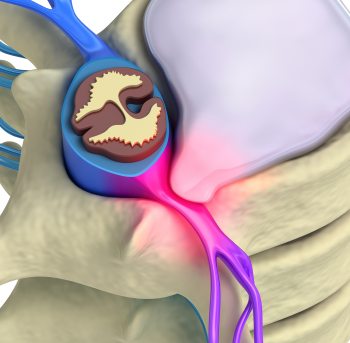
Tears or Cracks in Spinal Discs:  Small tears or cracks may develop in the outer portion of spinal discs. When this happens, the jelly-like interior may leak into these tiny tears or cracks causing them to bulge or rupture.
The development of degenerative disc disease can put pressure on the spinal cord and nerves causing pain and abnormal function.

Symptoms and Types of Degenerative Disc Disease

The symptoms of degenerative disc disease vary depending on the location of the spinal disc degeneration. If a spinal disc or multiple spinal discs in the neck region of the spine become degenerated, it may cause neck pain or arm pain. This is commonly referred to as Cervical Degenerative Disc Disease.
If a spinal disc or several spinal discs in the low back area of the spine become degenerated, it may cause low back pain or pain in the hips, buttocks and legs. This is commonly referred to as Lumbar Degenerative Disc Disease.
The degree of pain may also vary from numbness or tingling to intense pain that increases with movement.

Why We Will Help with Degenerative Disc Disease

The practice of chiropractic care focuses on the comprehensive health of the body’s spine and central nervous system. Our doctors of chiropractic are trained to identify and treat problems with the spine and nerves of the human body. When your spine and central nervous system are healthy and free from interference (called subluxations), you will be free from pain.
The best feature about chiropractic care is that it does not use prescription drugs or surgery to treat health care problems like degenerative disc disease. It’s safe and effective.

Find a Resolution for the Pain from Degenerative Disc Disease

Life does not have to be lived enduring the pain and discomfort of degenerative disc disease. Please give us a call at (386) 492-4881 or Schedule an Appointment today!